week 5 - Principles of programming
week 5
Control flows
- 1. Selection (Conditional/If-Else)
- 1.1 If
- 1.2 If-else
- 1.3 If - elif(else +if) - else
- 1.4 Nested if
Control flows
control flows:
- selection(if-else
- repetition(loop)
- Subprogram
1. Selection (Conditional/If-Else)
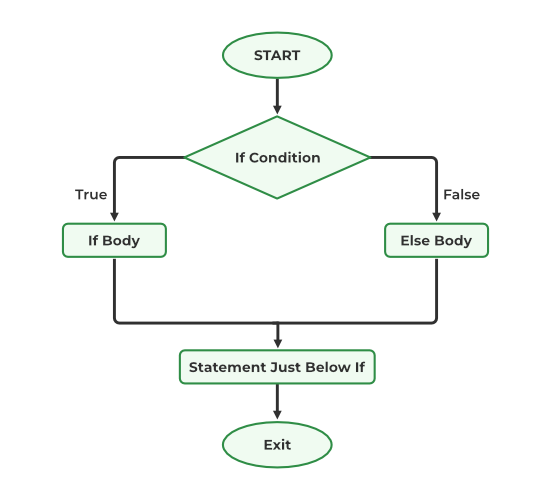
Controls which code executes based on conditions.
In flow charts, diamonds are used to represent a true/false condition.
 ### 1.1 If
#### Syntax:
```Python
if expression:
statement
statement
...
```
### 1.1 If
#### Syntax:
```Python
if expression:
statement
statement
...
```- After the
if expression, put a:(colon) - Each line inside the
if-bodyisindentedby the same amount - if body is executed only if the expression is True.
- zero --> false
- non-zero values --> True
Example:
amount = ... # 1000 , 500

if amount > 1000:
	print('You have a discount')
print(amount)
if-block: only executed if amount is greater than 1000print(amount): outside the scope of the if block, so if block will end there
1.2 If-else
Syntax:
if expression:
	statement(s)
else:
	statement (s)
- After the
if expressionandelse, put a:(colon) - Each line inside the
if-bodyandelse-bodyisindentedby the same amount - Only either if-body or else-body gets executed, not both
Examples:
amount = ... # 1000 , 500

if amount > 1000:
	discount = amount*0.10
else:
	disount = amount*0.05
print(discount)
if-block: only executed if amount is greater than 1000else-block: only executed if amount is less than or equal to 1000
name = ... # 'Perera'
gender = ... # 'male' , 'female'

if gender == 'male':
	print('Mr. ' + name) # string concatenation
else:
	print('Ms. ' + name) # string concatenation
1.3 If - elif(else +if) - else
Syntax:
if expression_1:
	statement(s)
elif expression_2:
	statement (s)
elif expression_3:
	statement (s)

...
else:
	statement (s)
- can use any number of
elifs but at last there must be aelse - conditions are executed from top to bottom, until one condition is satisfied.
Example:
amount = ... # 1000 , 500 , 2200

if amount > 2000:
	discount = amount*0.20
elif amount > 1000:
	discount = amount*0.10
else:
	disount = amount*0.05
print(discount)
if-block: only executed if amount is greater than 2000elif-block: only executed if amount is greater than 1000 and less than or equal to 2000else-block: only executed if amount is less than or equal to 1000
1.4 Nested if
if structure inside another if structure
Syntax:
if expression_1:
	statement(s)
	if expression_2: # start of inner if-elif-else
		statement (s)
	elif expression_3:
		statement (s)
	else:
		statement (s) # end of inner if-elif-else
else:
	statement (s)
- Each line inside the
if-bodyisindentedby the same amount
Example:
gender = ... # 'male' , 'female'
name = ... # 'Perera'
married = ... # True , False

if gender == 'female':
	if married == True:
		print('Mrs. ' + name)
	else:
		print('Miss ' + name)
else:
	print('Mr. ' + name)
- Outer
if-block: executed if gender is 'female' - Inner
if-block: executed if gender is 'female' and married is True - Inner
else-block: executed if gender is 'female' and married is False - Outer
else-block: executed if gender is not 'female'
Same example without nested if
gender = ... # 'male' , 'female'
name = ... # 'Perera'
married = ... # True , False

if gender == 'female' and married == True:
	print('Mrs. ' + name)
elif gender == 'female' and married == False:
	print('Miss. ' + name)
else:
	print('Mr. ' + name)